


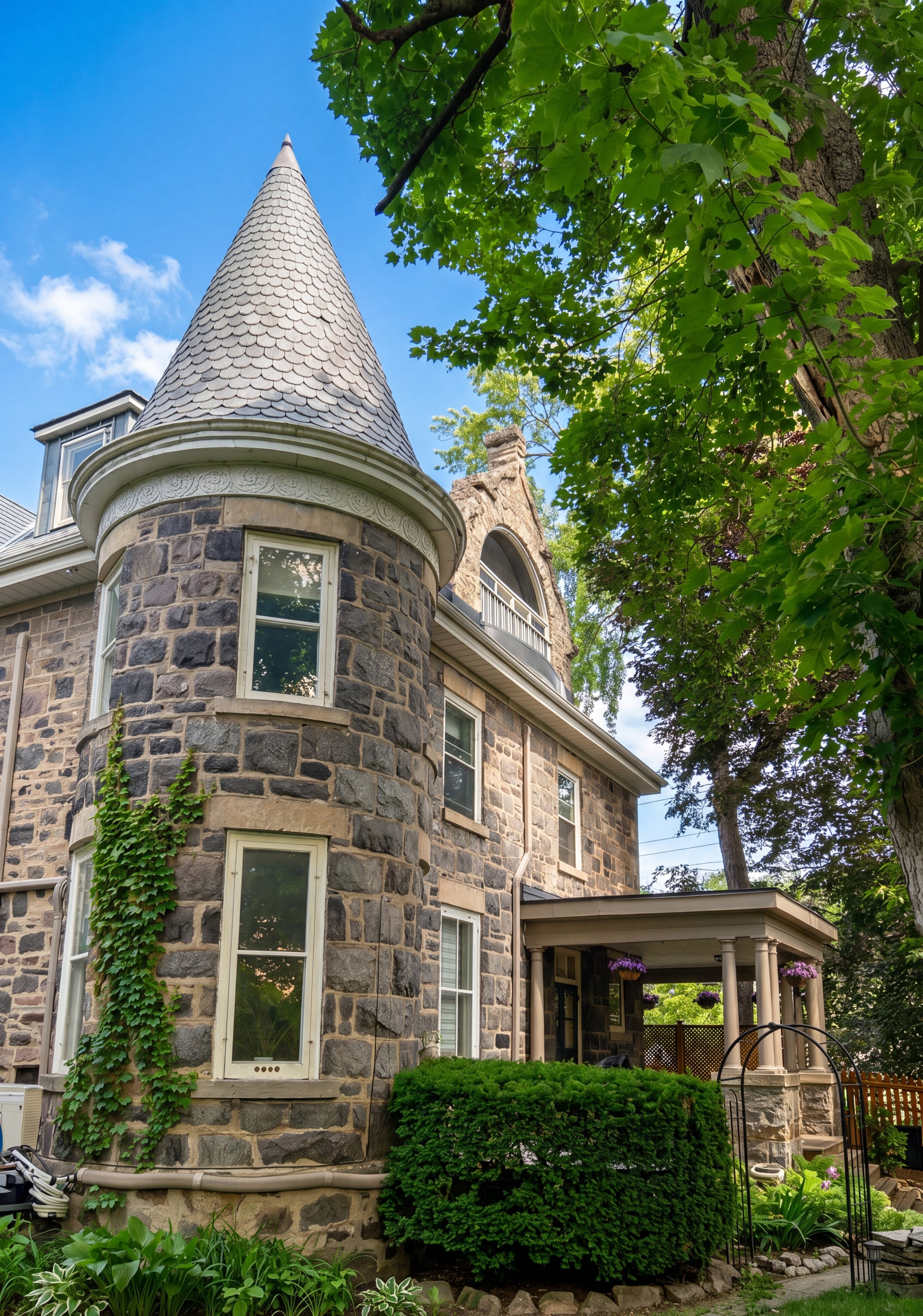
Currently Listed For Sale: 54 Bruce Street, Cambridge ON.
VIEW LSITING HERE
Every soft market I've worked through over the past 26-years, the same thing happens. Showings thin out and offers get careful. However, when century homes are priced well, and show well, they keep selling.
The data behind the instinct
July brought a fourth consecutive monthly gain in Canadian home sales. Inventory sat at 4.7 months, the lowest level so far in 2026 and slightly under the long-term average of 5 months. The National Composite MLS Home Price Index ticked up 0.1% from June, its first increase since November 2024 (CREA). Quiet numbers, but they lean the same way.
Builders are moving in the other direction. CMHC forecasts housing starts to fall 6.8% this year, to roughly 241,400 units, pointing to softer demand and high construction costs (CMHC, via Canadian Mortgage Trends). Less is being built precisely as buyers turn back toward what already stands.
Within that existing stock, heritage homes have a record worth knowing. Robert Shipley's study at the University of Waterloo tracked nearly 3,000 designated heritage properties across 24 Ontario communities, Windsor to Sault Ste. Marie. 74% held at or above their local market average. In declining markets specifically, 47% outperformed and only 21% fell behind (Heritage Resources Centre, University of Waterloo).
That last figure is the one I'd underline.
What's actually scarce
Limited inventory gets discussed like a passing condition. For century homes it's permanent. Canada has roughly 15 million buildings, and about 1.4 million of them, close to 1 in 10, went up before 1945. Meanwhile 80% of the buildings that will be standing in 2050 already exist today (National Trust for Canada). Nobody is making more of them, and there's no mill turning out old-growth timber or hand-set brick on demand.
New subdivisions widen the distance. In the Greater Toronto area, average frontage on new single-family detached homes slipped from 40 or 41 feet through 2015 to 2019 down to 37 feet in 2020. Across all ground-related housing the weighted average fell from 29 feet to 25. Builders trimmed lot depth to 70 or 80 feet from the old 100-foot standard, and lots in the 26 to 30 foot range grew from 6% of the market in 2000 to 15% by 2020 (The Globe and Mail, citing MCAP and Altus Group data).
Century lots were laid out before that math existed. They came with room, and room is what lets a tree become a tree. TD Economics valued Toronto’s urban forest at roughly $7 billion, about $700 per tree, returning between $1.35 and $3.20 in benefits for every dollar spent maintaining it (TD Economics). A 90-year-old silver maple is infrastructure you inherit.
The work already done
The money-pit reputation deserves a second look. On a great many heritage homes, the expensive work is behind you, paid for by an owner who came before.
Consider what those line items cost in Ontario now. A substantial rewire of a century home runs $15,000 to $35,000, and a large pre-1930 detached can reach $45,000 once you add a 200-amp panel and the plaster repair that follows the electrician (RenoHouse, Leo Constra). Replacing galvanized supply lines across the GTA averages around $7,500, with whole-home repiping between $4,500 and $15,000 (Anta Plumbing). Underpinning and reinforcing the stone foundation under a Victorian semi lands between $40,000 and $90,000 before a dollar of finishing (Leo Constra).
A house where all 3 are done can carry $60,000 to $140,000 of work you will never see. It doesn't photograph. It doesn't show up in the square footage. It shows up the day your insurer asks about knob and tube, because carriers are hesitant to provide coverage where active knob and tube remains, unless the work is done within 90 days of closing (Leo Constra).
So I ask sellers of older homes for their receipts, and I tell buyers to read them closely. A previous owner's careful decade is the most underpriced thing in a heritage listing.
Who's buying this way
The heritage buyer is a distinct animal. Most are established rather than first-time, buying with equity from a previous home and enough runway to take on a project. Many spent childhoods in a house built before the war, or summers in one, and the pull runs closer to memory than to taste. Others have simply toured enough new subdivisions to want a house that doesn't repeat itself three doors down.
They're handy, or willing to learn. 49% of Canadians report planning or recently finishing a renovation, with average expected spending of $19,000, close to double the $10,000 reported in 2019. 63% say they're driven by making a home their own and building its value (CIBC and Ipsos). Heritage owners sit at the deep end of that pool. They take on knob-and-tube wiring and lime mortar repointing as terms of ownership, work they agreed to when they signed the offer.
They also think long. 81% of Canadian mortgage consumers still describe homeownership as a solid long-term investment (CMHC 2026 Mortgage Consumer Survey), and the heritage buyer holds that view with unusual conviction.
The 5 features they love
Ask enough of them and the same short list comes back:
- Original millwork and trim, staircases above all
- Wide-plank or strip floors carrying a century of wear
- Transom, leaded, or wavy-glass windows
- A deep covered porch built for sitting
- A lot old enough to have real trees on it
Every one of those is something you cannot add later.
What they read
Canadian House & Home and OUR HOMES for the restoration features. Many belong to Architectural Conservancy Ontario and read its ACORN magazine, or follow the National Trust for Canada, which is where more than two-thirds of Canadians who say they care about conserving heritage places tend to land.
The most useful source is rarely printed. It's the branch meeting, or the neighbour two streets over who repointed her own chimney and will tell you exactly which mortar mix to avoid. This group learns from each other.
The steadier ground
Plenty of buyers want what new construction offers, and they should have it. What the Ontario evidence shows is that heritage homes carry their own kind of protection when markets soften. It matches what I watch happen in living rooms: these houses hold their people, and they tend to hold their value.
If you're weighing a century home against something newer, I'm glad to walk through what the numbers look like for your situation.
Sources
- Canadian home sales, July 2026, Canadian Real Estate Association
- CMHC 2026 housing starts and price forecast, Canadian Mortgage Trends
- Heritage Designation and Property Values: Is there an Effect?, Robert Shipley, Heritage Resources Centre, University of Waterloo
- Heritage Builds a Stronger Canada, 2025, National Trust for Canada
- Toronto area lot sizes continue to shrink, The Globe and Mail (MCAP and Altus Group data)
- Urban Forests: The Value of Trees in the City of Toronto, TD Economics
- Nearly half of Canadians are engaged in home renovations, CIBC and Ipsos
- 2026 Mortgage Consumer Survey, CMHC
- Knob and tube rewiring cost, Toronto 2026, RenoHouse
- Century home renovation cost, Toronto, Leo Constra
- Galvanized pipe replacement cost, Toronto and GTA 2026, Anta Plumbing
Check out this article next