


What a trade war does to a town like ours...
Three clients have asked me some version of the same question this month. One over coffee. One standing in a kitchen in a house we were getting ready to list. And one who called, circled it for a while, and finally landed on: should I be worried?
It deserves a real answer. So here's what I know, as of today.
What happened
Canada and the United States came very close to a deal last week. Close enough that on August 20 the Americans held off on new tariffs for 72 hours because an agreement looked likely. The terms shifted late, Canada walked away, and on August 22 the United States imposed 50% tariffs on roughly $28 billion of Canadian goods.
This morning Ottawa answered. Counter-tariffs on about 700 American products, tiered at 15%, 25% and 50%, effective September 8. Alongside them, $7.5 billion in support: expanded Employment Insurance with the one-week waiting period waived and 20 additional weeks of benefits for long-tenured workers, $1.5 billion through a regional tariff response fund, $500 million in business liquidity, and $2 billion toward finding markets outside the United States.
That second paragraph matters more to this region than the first one does, and it's getting almost none of the attention.
What it touches here, and what it doesn't
Worth being precise, because precision is calming.
The American measures in this round land on dairy, alcohol, cement and hockey equipment. Vehicles, auto parts and steel were left out of it. They have been threatened, and that threat is worth watching closely, though as of today they aren't in the package.
The distinction matters here. In Perth County and Waterloo Region it's the auto and manufacturing supply chain that reaches a household's income, and income is what eventually reaches a housing decision. Some of our neighbours have had a hard couple of years already. The Employment Insurance changes announced this morning are aimed directly at them, and they arrive before the tariffs do.
The upper tier behaves differently
Here is something rarely said plainly, and it's the part that matters most if you own a home at the top of this market.
The high end and the general market don't move together. In the Greater Toronto Area, sales above $4 million rose 21% in a year when overall GTA sales rose 2.6%. Above $10 million, sales rose 20%. Those are the same months, the same city, and two completely different stories.
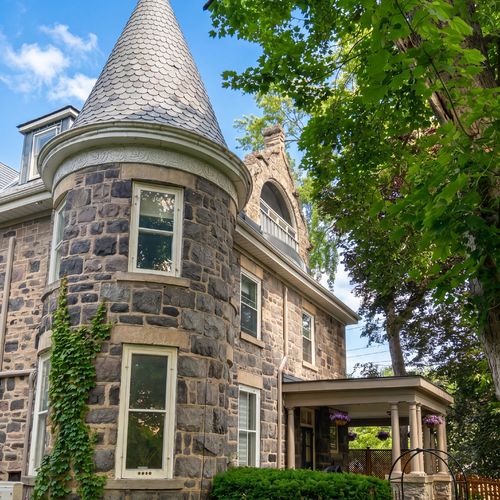
The reason is structural rather than sentimental. Purchases at this level lean heavily on cash rather than financing, so the mechanisms that usually carry an economic shock into housing (a rate move, a tightened lending rule, a difficult renewal) reach these buyers faintly. And the supply is fixed. Nobody is building another century home on a mature street with 80-year-old maples. Scarcity does work that new inventory can't.
Concentration is the other half of it. A newer subdivision is often a street where most households bought within a few years of one another, financed on similar terms, and in some regions work in the same handful of industries. When a sector takes a hit, that street tends to feel it at the same time. An established neighbourhood assembled over a century holds owners of every vintage and circumstance, which means it has no single point of failure. That's not a comment on anybody's street. It's a comment on how risk clusters.
Where the exposure actually sits
I'd be careful with any argument that the high end is simply safe, because it isn't, and the reason is specific.
A great many people buying at the top of this market are business owners, and a good number of them sell into the United States. Tariffs land on their revenue directly, often harder and faster than on anyone drawing a salary. A manufacturer in Kitchener with most of her sales going south is more exposed to this moment than nearly any household in the region. She may also be exactly the person who was going to buy a heritage home here this autumn.
So the honest version has two halves. Upper-tier property holds its value better through a downturn. The people who buy it are not therefore untouched, and some of them carry more risk than average. Both things are true and they pull against each other.
We have been here before
In June 2018 the United States imposed tariffs on Canadian steel and aluminum. Canada retaliated that July. The commentary at the time sounded a great deal like the commentary this week.
Those tariffs were lifted in May 2019. Eleven months, start to finish, resolved at a negotiating table.
Softwood lumber has been in dispute between these two countries since the early 1980s, through governments of every description on both sides of the border. It has flared and settled and flared again, and houses in Ontario kept being bought and sold the whole time.
None of that guarantees a quick resolution now. What it does is place this moment in a long line of similar moments, nearly all of which ended in an agreement, and nearly all of which felt permanent while they were happening.
Why this town holds its ground
Between 2021 and 2025, while national home prices slipped 1.9%, Stratford's rose 3.7%. Sales fell here too, though nowhere near as far: 19.8% against 29.2% across the country. Detached homes, the backbone of this market, finished the stretch up 2.5%.
There's a reason underneath those numbers. The Festival brings roughly $277 million in economic activity to this region every year and supports 1,466 jobs, more than a thousand of them here in town. In the year the study measured, visitors spent $147.3 million locally, $24.4 million of that in restaurants.
Something else has been working quietly in our favour. Canadians have changed where they travel. Trips to the United States fell 25% in 2025, the lowest level outside the pandemic years. Looking at 2026, 92% of Canadian travellers expect at least one trip within Canada, and 39% name supporting Canadian businesses as their reason for staying home.
Stratford is precisely the kind of place that catches that shift. A weekend inside driving distance, theatre, good food, and a town that feels chosen rather than settled for.
The conversation people are quietly having
There's a question I've heard more this year than in the previous five, usually raised sideways and then dropped before anyone has to commit to it.
It runs something like: what are we actually getting for staying?
The arithmetic behind it isn't subtle. The average Greater Toronto home sold for just over $1 million in July, and a detached home there averaged close to $1.3 million. Both figures are down from a year ago. In Stratford the average sits a good deal lower at $728,000 in July. Somebody selling a Toronto detached home at the average and buying well here keeps a meaningful sum and generally gets more house and a shorter walk to dinner.
This pattern well predates the tariffs. Toronto has lost roughly 45,000 residents to other parts of Ontario over the past four years, about 15 people per thousand every year, and that was happening while nobody was thinking about trade policy at all. RE/MAX found luxury activity this year growing fastest outside the traditional hubs, with Ottawa up 17.5% and gains in London and St. Thomas as well. Capital at the top of the market has been dispersing toward places people actually want to live for some time now.
I want to be careful here, because there's a version of this conversation that sounds opportunistic and I have no appetite for it. Moving is a life decision, made for reasons that have very little to do with spreadsheets, and it goes badly when the maths is the only reason for it.
What I'd say is narrower. If you've been circling the question anyway, the arithmetic is friendlier right now than it has been in a while. That's the whole of it. Worth knowing, and worth nothing at all if the life you want is the one you already have.
Where this likely goes
The talks have stopped for now. The Prime Minister has said negotiators go back when the terms are worth going back for. A number of observers expect the more realistic window to open after the American midterm elections in November, when the domestic politics of tariffs will look different than they do in August.
I'd call that cautious optimism, which is a different thing from confidence. The two sides were within days of an agreement a week ago. Most of the substance was settled. What broke was the final terms, and final terms can be revisited.
What I'd actually do
If you're thinking about spring, begin the quiet work now. The small repairs, the honest conversation about price. Homes that arrive at market prepared do well in every kind of year, and the ones that arrive rushed struggle even in the good ones.
If you're staying put, none of this changes the value of a home you love.
And if you're waiting for certainty before you decide anything, I'd gently point out that certainty has been in short supply since roughly 2019, and the people who held out for it are mostly still holding.
In the Greater Toronto Area last year, sales above $4 million rose 21%.
Overall GTA sales rose 2.6%.
Same city, same months, two completely different markets. It's worth understanding why, because it explains a great deal about what tariffs will and won't do to property values.
Purchases at the top of the market lean on cash rather than financing. The mechanisms that normally carry an economic shock into housing, a rate move or a difficult renewal, reach those buyers faintly. And supply is fixed. Nobody is building another century home on a mature street.
Concentration matters too. A newer subdivision is often a street where households bought within a few years of one another and work in a similar handful of industries. When a sector takes a hit, the street feels it together. A neighbourhood assembled over a century has no single point of failure.
The honest caveat: many upper-tier buyers are business owners selling into the United States. Tariffs reach their revenue faster than they reach anyone on salary. The property holds its value. The buyer may still be having a hard year.
Both things are true. Most commentary this month has picked one and run with it.
If you'd like to talk any of it through, my door is open. No agenda.
Sources:
- No, the GTA Housing Market Is Not "Turning" – Move Smartly
- It Took 22 Years For Prices To Recover From The Last Toronto Real Estate Crash – Better Dwelling
- A Brief History of Canada's Housing Market Crashes – Adam Mills Realty
- Sotheby's: Luxury housing market resilient despite economic waves – HousingWire
- GTA luxury housing market stays robust despite headwinds – RENX Homes
- Is Spring Really the Best Time to Sell Your Home? – RE/MAX Canada
- Luxury housing sales rise across smaller Canadian markets – RE/MAX via Newswire
Check out this article next